
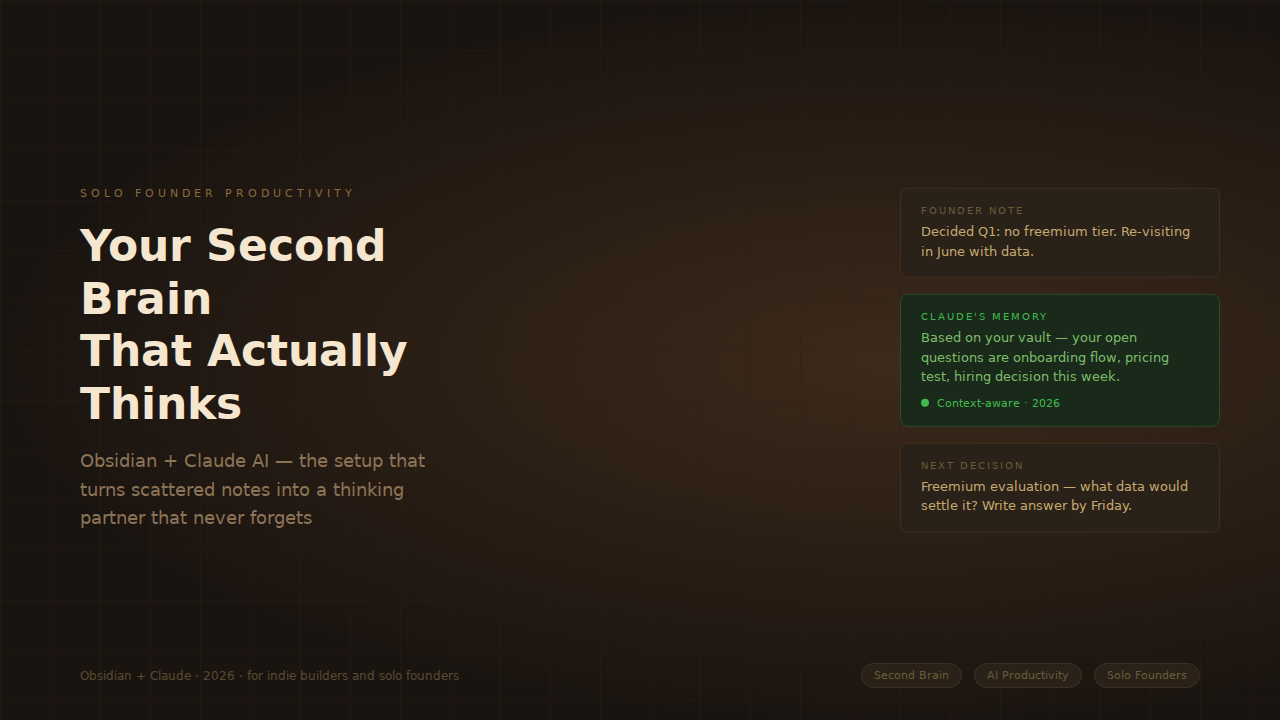
The average solo founder makes over 100 decisions a day with no one to check them against.
Product calls, pricing decisions, hiring, roadmap trade-offs. You make each one and move on. By the time you circle back, you've lost the thread — not because you forgot, but because you never had a system for capturing the context around each decision.
What you're missing isn't another AI tool. What you're missing is an AI tool that knows your project.
This guide covers how to build that with Obsidian and Claude — a setup that's gone from niche experiment to mainstream indie founder toolkit in 2026, driven partly by Greg Isenberg calling it "a personal operating system for building your startup," and partly by the February 2026 Bloomberg feature on "The Great Productivity Panic," where AI coding agents pushed thousands of founders to rebuild their operating systems around AI-native tools.
Before / After: What Changes When Your AI Knows Your Context
Before: You open ChatGPT or Claude. You paste context. You ask a question. You get a decent answer. You close the tab. Next session, you start over.
After: You open Claude. You ask "based on what we decided in Q1 about our onboarding flow, what are the risks of the approach we're considering now?" Claude reads your vault, finds the relevant decisions, and gives you an answer grounded in your actual thinking — not generic advice.
The difference isn't the AI. It's the persistence.
Why 2026 Is Different: The Two Changes That Made This Worth Revisiting
If you looked at Obsidian + Claude a year ago and dismissed it, here's what's changed.
1. The plugin ecosystem matured significantly. claudian, the most mature Obsidian-Claude integration, has 7,692 GitHub stars and a stable feature set. claude-obsidian, a lighter MIT-licensed alternative, has 839 stars. Both do the core job well: they let Claude read your vault and reason about your project. The gap between "works in theory" and "works reliably" closed in 2025–2026.
2. Voice mode arrived in Claude Code (March 3, 2026). Anthropic added voice mode to Claude Code, which means you can now think out loud to your second brain. Record a thought on a walk. Transcribe it. Drop it in Obsidian. By next morning, Claude has it. For founders who do their best thinking away from the screen — in the shower, on a run, at 2am — this closes the friction gap that made earlier setups feel like overhead rather than leverage.
The Specific Problems This Stack Solves
Not every productivity problem. The ones that are most expensive when you don't have a co-founder.
Decision decay. You made a call in January that you wouldn't add a freemium tier. You wrote it in a doc somewhere. By March, a customer email lands asking about freemium, and you evaluate it as if you're seeing it for the first time. Obsidian makes that call a note. Claude retrieves it and reminds you what you decided and why.
Context switching tax. You spend two hours building, then take a customer call, then come back to the keyboard and spend fifteen minutes remembering where you were. Obsidian holds the thread between sessions. You write the note, you go to the call, you come back and the context is there.
The lost 2am thought. Most founders do their best strategic thinking at night or in the margins of the day. Without a capture system, those thoughts disappear by morning. With this stack, you write the note. Claude has it. The insight compounds.
Vendor lock-in anxiety. Your vault is markdown files on your machine. If Obsidian the company changed direction tomorrow, your data is plain text you own. The integrations work with the files, not the app. This matters more than it sounds — a lot more for indie builders who've been burned by SaaS pricing changes breaking their workflows.
The Honest Drawbacks (Before You Start)
You have to write things down. Not just tasks — decisions, context, thinking. If you don't take notes at all currently, this will feel like work. If you keep a running mental list because you don't trust notes anywhere else, this is the fix.
Early vault is mostly empty. Six months in, your Obsidian vault is genuinely powerful. Week two, it's a folder with three notes. The compounding is real but it's delayed. Founders who quit in month one miss the payoff.
Plugin overload is a real risk. Claudian is solid. Other plugins vary in quality. Installing five plugins at once and wondering why nothing works is a common mistake. Start with one. Build the habit. Add the next.
It's a thinking partner, not an AI employee. This stack augments your thinking. It won't build your product while you sleep. For that, look at Claude Code or Cursor as standalone tools — they're better suited to autonomous coding work.
How to Set Up Obsidian + Claude for Your Indie Project
Step 1: Download Obsidian Go to obsidian.md and download the app. Core functionality is free. Pay only if you want Sync (cross-device) or Publish (public site hosting).
Step 2: Install claudian The most mature integration. Find it on GitHub — search "YishenTu claudian." The setup guide takes about 20 minutes. You connect your Claude API key, point it at your vault, and you're done.
Alternative: claude-obsidian (MIT licensed, 839 stars) if you want something lighter. Both work. Claudian is more feature-complete.
Step 3: Create your project folder In Obsidian, create a folder for the project you're currently building. Name it after the product. This is where your thinking lives.
Step 4: Write your first three notes
- What I'm building: one paragraph on the product and who it's for
- What I'm unsure about: list the three biggest open questions
- Next decision: what decision needs to be made this week, and what information would settle it
Step 5: Ask Claude a specific question Don't say "analyze my project." Say: "What are the biggest risks in our current approach, based on what I've written in this vault?"
Claude reads the folder. You get feedback grounded in your actual context.
Step 6: Build the daily capture habit End of each day: five minutes, one note. What did you decide today? What's the next thing? What surprised you? That's it.
Over six weeks, your vault becomes a working memory for the project. Over six months, it's a strategic asset that compounds in value.
The Plugin Stack to Know for 2026
Beyond the core Claude integration, a few Obsidian plugins are worth knowing:
- Daily Notes — creates a note for each day automatically. Great for capturing thoughts without thinking about file organization.
- Templater — lets you create templates for recurring note types (decision logs, meeting notes, feature reviews). Reduces friction for daily capture.
- Breadcrumbs — useful if you're building a knowledge graph instead of a linear list. Helps you navigate complex vaults.
The dsebastien Obsidian plugin roundup for 2026 is the most complete current guide — worth reading before you add more than two plugins.
Is This Setup Right for You?
Yes, if:
- You're a solo or small-team founder who already takes notes (even loosely)
- You want AI that knows your project context and can reason about it
- You're comfortable with a small daily habit of capturing decisions and thinking
- You're building something where strategic decisions compound over time
Probably not, if:
- You want AI to do the building, not augment your thinking (look at Claude Code or Cursor for that)
- You have no note-taking habit and no intention to build one
- You need a system that works without any ongoing engagement from you
The setup takes an afternoon. The habit takes a few weeks. The payoff is a thinking partner who was in the room for every decision — and never forgets a single one.