
Every week, another indie founder posts a thread about what they're building. The comments are warm. The engagement is real. The sales don't come.
This pattern has become so common that the community that invented "build in public" is now openly questioning whether the strategy works. This article is a diagnostic — not a eulogy.
Build in public is not dead. But for a growing number of indie founders in 2026, it has become a trap disguised as a tactic. Here's why, and what to do instead.
The Uncomfortable Signal: Why the Community Is Questioning Build in Public
In April 2026, a Hacker News commenter argued that building in public gives indie founders roughly a 99% chance of ending up building for other indie hackers rather than mainstream customers. The thread didn't erupt in disagreement — it erupted in recognition. Hundreds of founders saw themselves in the description.
This wasn't an isolated incident.
On Indie Hackers, a breakdown of why indie founders fail identified eight distinct failure modes. Build in public was not the main one. The real killers were deeper: falling in love with solutions before understanding problems, neglecting distribution, and running out of energy during what one analyst called "the messy middle" — roughly months 3 through 18 of building.
A thread on r/indiehackers titled "Is Building in Public Really the Right Way?" has been running for weeks with no clean resolution. The community that popularized the strategy is now the community most actively debating it. On r/SaaS, a contrarian take — that building in public in 2026 is simply doing marketing badly — has been accumulating upvotes and agreement.
The evidence here is community-sourced, not industry-report quality. But the convergence is hard to ignore: multiple independent discussions, all happening simultaneously, all pointing in the same direction.
The Closed Loop: Why It Happens
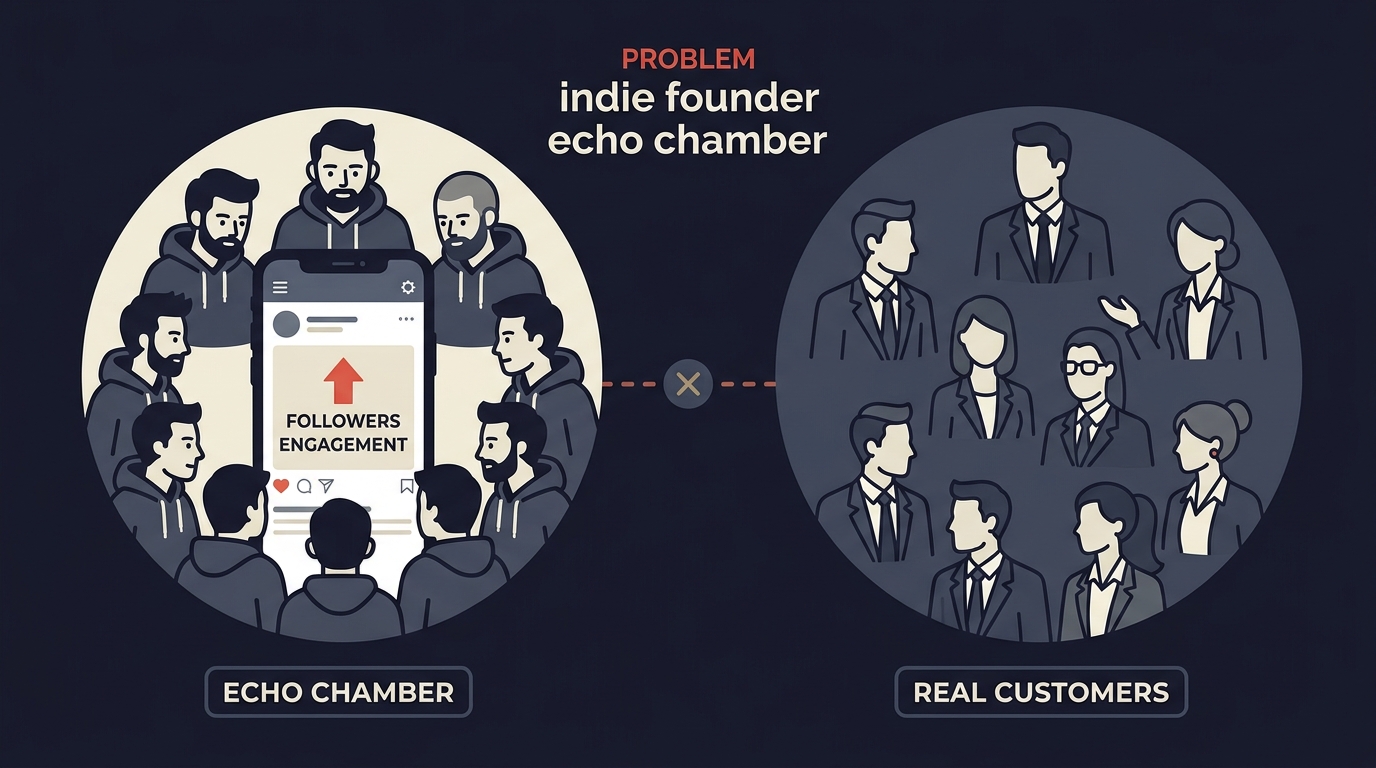
The structural problem is this: indie founders are the most reachable audience on the internet.
When you post publicly about your build, the people most likely to engage are the ones already embedded in the founder ecosystem. They're sympathetic. They comment. Some buy. But most of them are fellow travelers — "wantreprenuers with imagined problems," in the words of one HN commenter — not the mainstream customers you're trying to reach.
The more you optimize for their engagement, the further you drift from your actual addressable market.
This isn't a character flaw. It's a structural trap baked into the strategy. Building in public works by default for the audience that's already paying attention to build-in-public content. If that audience isn't your customers, you're building an audience of the wrong people.
The trap closes slowly. Followers accumulate. Engagement feels like progress. But the product is being refined for a community that will never be the mainstream market — and at some point, the founder notices the gap between their follower count and their MRR.
Before and After: The Two Modes of Indie Founder Marketing
Before build in public became a strategy: Founders talked to customers directly. They sent DMs, attended niche communities, asked for intros, chased referrals. Slow, scrappy, but targeted. The people you talked to were the people who might buy.
After build in public became a strategy: Founders posted publicly and waited for the audience to form. The audience formed — it just wasn't the right audience. Followers grew. Customers didn't. The strategy looked like marketing but functioned like a hall of mirrors.
The founders who still succeed with build in public tend to use it as a credibility layer on top of direct outreach — not as a replacement for it. They build in public to show proof, then reach out directly to close.
The 8 Failure Modes (and Why Build in Public Is Rarely the Root Cause)
Indie Hackers' breakdown identified eight ways indie founders fail. Build in public shows up in exactly one of them — not as the primary cause, but as a symptom of deeper problems:
- Falling in love with a solution before understanding the problem — building publicly amplifies the wrong thing
- Neglecting distribution — build in public is not a distribution strategy; it's a content strategy
- Burning out during the messy middle — posting build updates feels productive; it often isn't
- Optimizing for the wrong metrics — follower growth vs. customer conversations
- Building for the audience instead of the market — the feedback loop is broken
- Running out of cash before finding traction — time spent on content is time not spent on sales
- Failing to cross the chasm — indie hacker audience and mainstream market are different
- Not finding a few deep believers early enough — direct relationships beat public reach
Build in public doesn't cause these failures. But it can mask them. When your content is getting engagement, it's easy to mistake engagement for traction.
When Build in Public Still Works
This is not a case for abandoning the strategy. It still works — in specific niches with specific audiences.
Developer tools: The developer community is embedded in the online founder conversation. If your product targets developers, building in public is a legitimate primary channel.
B2B SaaS targeting technical buyers: Technical buyers research and buy through the same communities where build-in-public content lives. If your ICP is a CTO or engineering lead, the room is full of your customers.
Creator economy products: If your audience is other creators, the founder ecosystem is your market. Build in public works.
The failure mode arrives when indie founders with B2C or general SMB products adopt a strategy designed for a different customer profile. The content machine runs. The followers grow. The customers don't convert.
A Practical Framework for Deciding Where to Spend Your Energy
If you're an indie founder wondering whether build in public is worth your time, ask yourself two questions:
1. Are my actual customers in the room where I'm building?
If your target market is other indie founders, developers, or technical buyers — yes. Build in public is a legitimate channel. If your target market is mainstream SMBs or consumers, probably not.
2. Is build in public generating direct conversations or just engagement?
Engagement is a vanity metric. A conversation is a signal. If your build updates are generating comments but not DMs from potential customers, you have an audience, not a pipeline.
The Fix: Combine Public Visibility with Direct Outreach
The founders who break out of the loop do two things simultaneously.
They build in public to establish credibility — proof of work, proof of progress, proof of existence. This matters, especially in markets where trust is built before transactions.
But they also spend meaningful time in direct conversations with potential customers — DMs, warm intros, niche communities where signal-to-noise is high. Not to grow an audience, but to understand what people actually need.
And when it comes to shipping faster — so that the product itself becomes the marketing — Wispr Flow removes the friction between thought and code. Voice-to-code means less time managing a content calendar and more time building the thing that will eventually do the selling for you.
The Bottom Line
Build in public is not dead. It is, however, misaligned for a growing number of indie founders who adopted it without checking whether their customers were in the room.
The question is not whether to build in public. The question is whether your actual customers are watching. If they're not, the strategy needs to change — not the product, not the effort, just the direction.
Go find your customers. Talk to them directly. Build the thing. Then build in public from a position of proof rather than hope.